
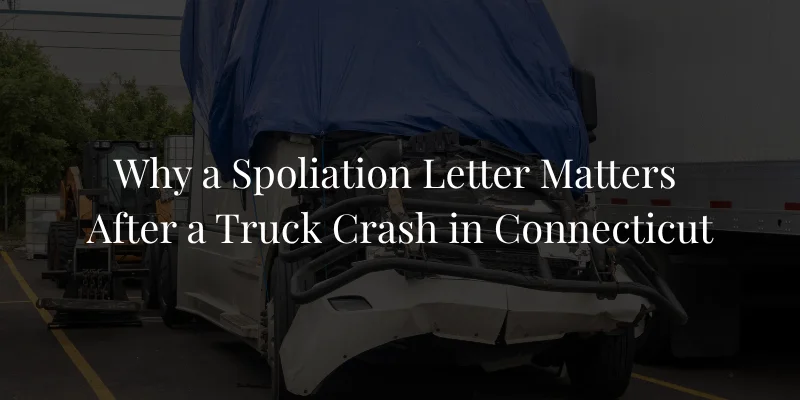
Understanding why a spoliation letter matters after a truck crash in Connecticut is important for those who have suffered damages. A truck accident spoliation letter is a formal letter requesting a trucking business to preserve evidence related to a collision. Following a commercial truck collision on Interstate 95 near New Haven, I-84 via Hartford, or Route 8 in Waterbury, crucial records may be retained solely by the trucking company.
Electronic data and other documents may disappear before investigators can identify what caused the crash.
What Truck Accident Evidence Should Be Preserved?
Unlike typical passenger cars, commercial trucks frequently produce extensive operations logs. A preservation request may specify multiple categories of evidence.
- Electronic Logging Device (ELD) Records. These records show driving hours and duty status. They can assist investigators in determining whether a driver surpassed federal hours-of-service restrictions or failed to take needed breaks.
- Dashcam and electronic vehicle data. Camera footage may disclose lane shifts, traffic patterns, or driver behavior before the accident. The electronic control module information may additionally include information regarding the vehicle’s speed and braking.
- Maintenance and inspection records. Repair history, inspection reports, and recorded mechanical flaws can help determine whether a trucking company overlooked known safety issues.
- Dispatch and communication records. Delivery instructions, GPS data, and interactions between drivers and dispatchers can indicate scheduling conflicts or contradictions in the driver’s report.
Why Does Evidence Preservation Matter in Connecticut Truck Accidents?
Truck accidents frequently raise complicated liability issues. According to the National Highway Traffic Safety Administration (NHTSA), by 2024:
- In major truck crashes around the country, 5,340 people were killed.
- 70% of fatalities included passengers of other vehicles.
- 76% of deadly truck accidents happened on weekdays.
Determining liability involves looking into whether driver negligence, equipment problems, or trucking business procedures contributed to the crash. A spoliation letter formally outlines the evidence that should be kept. It also helps to prove that the receiver was made aware of the prospective litigation and the need to keep relevant records.
Why Timing Is Important Before Evidence Disappears
Under 49 CFR § 395.8, auto carriers must keep drivers’ duty status records and supporting paperwork for at least six months. Other electronic material, such as certain dashcam recordings, may be wiped sooner, depending on business processes and retention policies.
When the evidence is significant to future litigation, a preservation letter can request that it be retained beyond the normal destruction schedule. Missing evidence in Connecticut vehicle accident cases might make it difficult to prove negligence under Connecticut General Statutes Section 52-572h. Courts may also consider proper remedies when crucial evidence is wrongfully deleted, based upon the circumstances.
Hire a Truck Accident Lawyer
When a commercial carrier controls significant evidence, it is important to hire a truck accident lawyer right away. When necessary, a Connecticut truck accident attorney might request preservation, locate pertinent documents, and ask the court to step in. To assess disputed liability, a lawyer can also compare electronic documents with crash reconstruction results and witness accounts.
Why Choose Weber & Rubano?
Lou Rubano and R.J. Weber III founded Weber & Rubano, which provides almost a century of collective legal experience in Connecticut matters. Our firm, which has offices in Wallingford and New Haven, manages motor vehicle injury cases involving significant damages and contested fault. For a free consultation regarding preserving evidence, understanding truck accident laws, and assessing your truck accident claim, contact Weber & Rubano right away.


